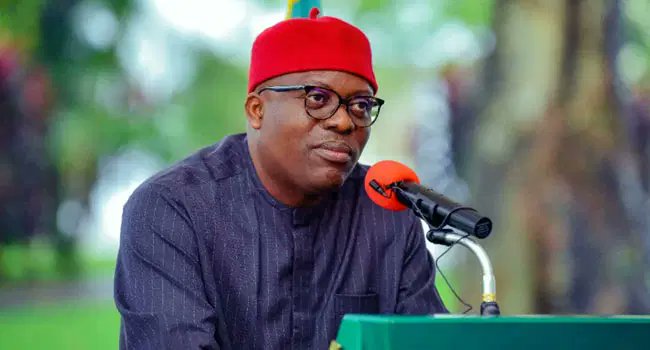
Rivers State Governor Siminayi Fubara officially left the People’s Democratic Party (PDP) to join the All Progressives Congress (APC). He announced his defection during a meeting with stakeholders at Government House in Port Harcourt on December 9, 2025.
His decision came four days after Rivers State Legislative Assembly Speaker Martin Amaewhule and 17 other legislators also left the PDP to join the APC on December 5.
Among those who defected were Dumle Maol (Gokana), Major Jack (Akuku-Toru), Linda Stewart (Okrika), Franklin Nwabochi (Ogba/Egbema/Ndoni), Azeru Opara (Port Harcourt 3), Smart Adoki (Port Harcourt 2), and Enemi George (Asari-Toru 2). Others included Igwe Aforji (Eleme), Tekena Wellington (Asari-Toru 1), Looloo Opuende (Akuku-Toru 2), Peter Abbey (Degema), Arnold Dennis (Ogu/Bolo), Chimezie Nwankwo (Etche), Gerald Oforji (Oyigbo), and Ofiks Kabang (Andoni).
Following his departure, it was reported that pressure increased on the governor to join the ruling party, the APC. However, after the DPP’s defeat to the APC in the 2015 presidential elections, significant reorganizations began across the region, as several influential political figures switched sides.
Before his defection, Fubara was the only remaining DPP governor in the South-South region. His decision comes after the recent defections of Delta State Governor Sheriff Oborevwori and Akwa Ibom Governor Umo Eno, who both joined the APC earlier this year. With Fubara’s switch, Rivers State now has an APC governor for the first time since 1999, ending the PDP’s decades-long hold on the oil-rich state.
Many political observers argue that the PDP’s grip on Rivers began to weaken when former Governor Nyesom Wike openly supported APC candidate Bola Tinubu during the 2023 presidential election. Several PDP leaders described the move as anti-party. Following Tinubu’s victory, he subsequently appointed Wike minister of the Federal Capital Territory.
A protracted disagreement between Wike and Fubara deepened tensions in the state. The rift triggered clashes between legislators loyal to Wike and those aligned with the governor. The crisis worsened with the partial demolition of the Assembly complex by forces allegedly loyal to Fubara and attempts at impeachment by legislators loyal to Wike.
President Tinubu intervened on March 18, declaring a state of emergency. He suspended the governor, his deputy governor, Ngozi Odu, and the legislators, and appointed retired Vice Admiral Ibok Ete as administrator. When the state of emergency ended on September 17, the president reinstated all suspended officials.
Meanwhile, the DPP continues to grapple with internal problems following its defeat in the 2023 presidential election. The party remains divided into two national factions, with expulsions and counter-expulsions exacerbating its ongoing crisis.
SOURCE: Channeltv




Be the first to comment